
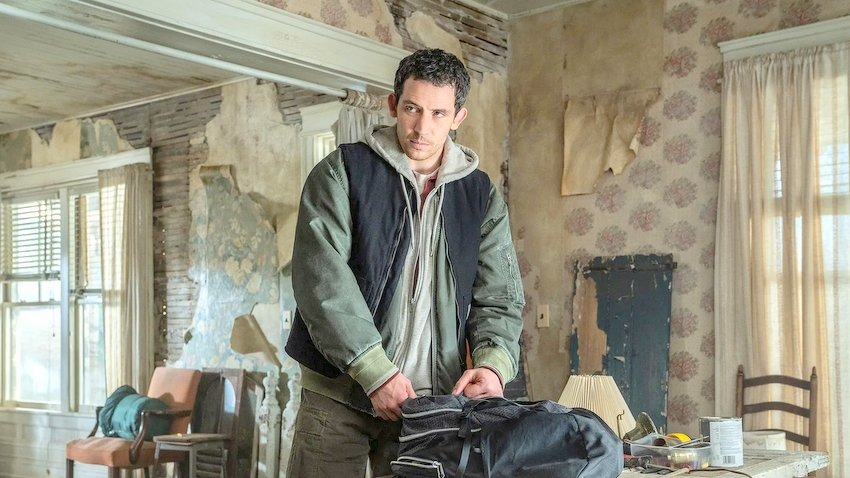
REVIEW: by Peter Nichols | 7 of 10 Stars
Logline
A meteorologist and a cybersecurity expert find themselves at the centre of a movement to expose the government’s cover-up of extraterrestrial secrets.
Introduction
There are filmmakers who reinvent themselves with every movie. Then there’s Steven Spielberg, who occasionally looks at his own filmography and says, “What if we did that… again?” Disclosure Day feels exactly like that—a familiar blend of family drama, government conspiracies, extraterrestrial mystery, and ordinary people stumbling into extraordinary events. If you’ve seen Close Encounters of the Third Kind, E.T., War of the Worlds, or even The Fabelmans, you’ll recognize the emotional DNA almost immediately. That’s not necessarily a criticism. Sometimes comfort food is exactly what you’re hungry for.
Story (Spoiler-Free)
The film follows Margaret as she becomes entangled in a mystery WARDEX involving hidden aliens, alien technology, secret government operations, and the possibility that humanity has been living beside a truth too enormous to comprehend. Rather than racing from explosion to explosion, Spielberg lets the mystery unfold through people. Government agencies conceal. Ordinary citizens slowly realize something impossible may actually be happening. The premise is particularly groundbreaking, and it provides plenty of room for suspense, wonder, and genuinely memorable surprises.
Writing & Storytelling
Spielberg has always understood that audiences rarely fall in love with spaceships. They fall in love with the people looking at them. That’s where Disclosure Day succeeds. The screenplay invests enough time in its characters that the larger science-fiction mystery carries emotional weight. Conversations feel lived in, relationships matter, and even supporting characters leave an impression. Where the writing stumbles is in its convenience. One sequence, involving Margaret casually entering what should be an incredibly secure facility and leaving with the alien archive data, asks the audience to suspend not just disbelief, but common sense. It feels less like clever writing and more like the screenplay quietly whispering, “We need to get to the next plot point.” It’s one of the film’s few moments that breaks the illusion.
Direction
Watching Spielberg direct almost feels unfair. Even when the material is revolutionary, his command of visual storytelling remains remarkable. He knows exactly when to linger on a face, when to let silence do the work, and when to hold back spectacle until it actually means something. The filmmaking and story telling is fluid. That said, I kept waiting for him to challenge himself. Disclosure Day often feels like a director revisiting familiar emotional territory rather than discovering new cinematic language. It plays like a “classic Spielberg” movie—and while that’s certainly better than most filmmakers at their best, I couldn’t shake the feeling that I expected more. Bigger. Bolder.
The Official Trailer for Disclosure Day Directed by Steven Spielberg
Acting
This is the film’s greatest strength. There isn’t a weak performance in sight. The cast delivers natural, emotionally grounded performances that make the extraordinary premise believable. Nobody is performing for the camera. They react like people trying to understand events completely outside human experience. That authenticity carries the film through its quieter stretches.
Cinematography
Beautiful without announcing itself. The cinematography avoids unnecessary flashiness, instead embracing Spielberg’s long-standing philosophy that the camera should serve the story. The Alien and the technology is mysterious without becoming over-designed. The government facilities feel appropriately equipped with modern technology, elegant, and not clinical. The domestic spaces remain warm and human. It’s polished craftsmanship from artists who clearly know exactly what they’re doing.
Pacing
Here’s where my relationship with the film became complicated. Overall, the pacing works. The narrative steadily builds toward its larger revelations, and the final act delivers satisfying momentum. I found myself drifting in and out of engagement. Not because the film is poorly edited—but because some stretches feel familiar. You occasionally recognize the rhythm before the scene even finishes, making certain moments less exciting than they could have been. It’s never boring enough to lose you. It just occasionally asks for a little more patience than it earns.
The Standout Moments
Two scenes lingered long after the credits rolled. The first is the astonishing moment when the alien archive is finally broadcast worldwide. For a brief instant, the world simply… stops because they see the truth. A knowledge long kept secret. It’s one of those rare Spielberg moments where spectacle isn’t about destruction or visual effects, but about collective human realization. You can feel the world holding its breath. The second comes earlier, at the fire station. Margaret holds the mysterious alien tool while WARDEX agents stand face to face—unable to see, hear or perceive her or her new friends despite their physical presence. It’s eerie, mysterious, and wonderfully cinematic. The sequence captures the kind of childlike wonder Spielberg has spent decades perfecting.
Themes
Like many Spielberg films, Disclosure Day isn’t really about aliens. It’s about people. Truth versus secrecy. Fear versus curiosity. Family versus institutions. Hope versus control. Friends reuniting. The science fiction becomes a vehicle for asking how humanity responds when its understanding of reality suddenly changes. The final word spoken in the film—“Listen”—perfectly captures that idea. Not fight, not panic. Not conquer. Listen. It’s a surprisingly elegant note to end on.
Final Verdict
Disclosure Day is a good film. Not a Spielberg masterpiece. Not Spielberg’s boldest work. But a culmination of all his sci-fi films – “We are not alone!” It is certainly one for the watching. Disclosure Day delivers strong performances, polished filmmaking, genuine great emotional moments, and enough mystery to keep audiences invested. While it occasionally leans too heavily on familiar Spielberg territory and a few convenient plot shortcuts, it never loses its sense of wonder. Perhaps that’s my biggest takeaway. I enjoyed it. I hoped Steven Spielberg would surprise me more than he did. Instead, he reminded me “He’s Steven Spielberg.” Sometimes that’s enough.
Disclosure Day: A familiar journey filled with heart, memorable performances, and moments of genuine awe. It may not redefine Spielberg’s legacy, but it comfortably earns its place alongside the family-driven science-fiction stories that made him one of cinema’s greatest storytellers.
Let’s have your comments below
FILM REVIEWS

Thelma Adams: Why Tyler Perry Earns the Title of Hollywood’s Last Auteur
Tyler Perry is the critical elephant in the room as Hollywood elites discuss diversity.

Thelma Adams: Mike Nichols Had ‘Carnal Knowledge’
When Carnal Knowledge (Mike Nichols) came out in 1971, I was twelve. The name sent shivers up my spine.

Movie Review: I, Tonya. Victoria Alexander
REVIEW: Film Critic Victoria Alexander

Movie Review: Star Wars: The Last Jedi. Victoria Alexander
REVIEW: Film Critic Victoria Alexander

