High-stakes gambling, with its unstable blend of chance, deemed risk, and life-wrenching stakes, is one of the surest sources of narrative tension in cinema. As an aspiring filmmaker, the gambling cinema genre, which includes such movies as Casino, Uncut Gems, and Rounders, is not just about people who win or lose money. It is a refined masterclass of movie-making art, wherein all technical choices, such as camera movement, sound design, etc., are used to manipulate audience anxiety and anticipation.
This piece of analysis deconstructs the technical structure of blockbuster movies and how master filmmakers and scriptwriters bring to life the abstract idea of luck and fate into a tangible cinematic dread. Through learning these mechanics, fledgling filmmakers can know how to create instant, visceral immersion, whether it is a poker table or a political thriller.
I. Screenwriting Architecture: The Inescapable Conflict
What has made the gambling genre so resilient is a structural agreement of its own: the act of making a bet is the same as the archetypal structure of narrative suspense. Any gamble consists of three critical elements, namely the bet (promise), the waiting (tension), and the result (resolution). A good screenwriter can apply the predetermined mechanics of the game (the flop, the turn, the river in poker; the spin of the wheel) as natural drama rhythms to carefully time the information and tension entering and leaving.
The trick of the successful high-stakes screenwriting is developing the Inescapable Problem. The lead character should be stuck in his situation where they cannot give up their cause easily. The narrative stakes disappear in case they are allowed to simply walk away.
The Character Trap: Addiction and Consequence
The genre provides fertile ground for exploring extreme psychological states, ranging from strategic intelligence to profound self-destruction.
Rounders (1998): The Crucible of Egos
Rounders is the archetypal pedagogic book on escalation. The movie makes sure that its high-stakes poker matches are not merely all about money, but are test-tubes where egos, morality, and character turn to in a time of crisis. The bad choices of Mike McDermott keep involving him with more than they can manage, and that causes him to engage in the problem where his ambition and talent are constantly challenged by his self-destructive urge.
The Gambler (1974): The Addiction to Losing
This movie has taken the edge off gambling and made it glamorous, as it centers on the negative side of addiction. The main character, Axel Freed, is not obsessed with the excitement of winning, but, in fact, he is disappointingly obsessed with losing and self-destruction. The benefit of the film is that it can put this profoundly internalized nihilism on a tangible, financial plane. To students of screenwriting, it illustrates how to make a theoretical psychological idea (pathological gambling) come to life in a high-stakes story conflict.
Uncut Gems (2019): The Addiction to Chaos
The screenplay of Uncut Gems by the Safdie Brothers is a masterpiece of the structural anxiety that is relentless. The conflict is fuelled by making Howard Ratner (Adam Sandler) an addict who values the process of betting and the need to bring about chaos over the money and the possible aftermath. It is a plot that is a machine of escalation since each relationship and interaction brings in a new source of anxiety. The self-destruction instinct of Ratner is refined into an apparent obsession with sports betting that dominates the movie. The panicizing opal, which is uncut, is an ideal symbolic hot potato that is always thrown back and forward between the opposing sides and structurally binds the film to a sense of complete, overwhelming overload.
II. Directorial Vision: Contrasting Styles of Tension
Formal decisions of a director, movement of the camera, editing rhythm, color, and tempo are the formal arguments on the topic. The technical course of gambling cinema can be most clearly perceived with regard to a juxtaposition of two approaches of masters: the maximalist spectacle and the subjective, visceral chaos.
Case Study A: Martin Scorsese’s Maximalist Spectacle (Casino, 1995)
Scorsese’s direction in Casino is defined by a maximalist aesthetic that replicates the sensory overload and decadent corruption of 1980s mob-run Las Vegas.
- Kinetic Staging and Editing: The movie plays with a mobile camera intensively, using a number of tracking shots, zooms, and fast zoom pans. These are continuous, fast-moving movements that are cut rapidly, rendering the manic energy and size of the system. This surplus of the form, the overloading of the picture by visual data, not only glorifies but also criticizes the spectacle of the crime system of Vegas.
- Thematic Argument: The approach of Scorsese suggests that the system is great, awesome, and, in the end, corrupting, which drives the viewer to admiration and awe of its huge, dangerous power.
Case Study B: The Safdie Brothers’ Subjective Chaos (Uncut Gems, 2019)
In stark contrast to Scorsese, the Safdie Brothers aimed for a visceral, anti-glamour aesthetic, consciously rejecting glamorous visuals.
- Visceral Pacing and Lensing: The filming crew wanted to have the action appear as though it were being unspooled in front of your very eyes and develop a feeling of unscripted tension. The visual rhythm creates the sensation of stifling. This pressure is also buttressed by the lensing decision: the anamorphic lenses are not employed to give the sense of an epic but rather an amplifying glass, a highly intense, claustrophobic attention on the mental breakdown of the protagonist and the details of the immediate environment.
- Dual Dialogue and Acoustic Overload: The Safdie Brothers often use Dual Dialogue, which is speaking two or more characters at the same time, bringing in alternative conversation lines. This conscious acoustic and narrational overload puts strain on the viewer, and one is left with a subjective feeling of nervousness and an apparent inability to control this, just like the mind of the addict.
- Thematic Argument: The gritty, overloaded style of the Safdys makes the viewer enter into the headspace of the addict, which is filled with anxiety and stress because it is hard to overcome the pathological addiction, and it is inherently destructive.
III. Visual and Acoustic Engineering of High Stakes
In addition to structural pacing and the style of directors, the technical mastery of a film is in how carefully cinematography, lighting, and sound are used to play around with the audience’s emotional reaction.
Cinematography: Framing the Pressure
Lighting design in high-stakes scenes achieves both psychological effect and visual sophistication.
- Low-Key Lighting: Suspense can be created by the moviemakers using the low-key lighting, which consists of dark, high-contrast light to redirect the concentration on the face of a character, a particular stack of chips, or a decisive card reveal. The dramatic side lighting, as was used in Casino, highlights the intensity of an extremely heated internal situation of an actor. Depth of the calculated light contrast is used primarily through character focus, which leaves the psychological drama against the visual clatter of the casino floor.
- Framing for Micro-Tension: The genre depends on the artful use of tight shots – characterized as paying special attention to hands, faces, or a game component – to shoot up subtle movements and micro-expressions into high-stakes psychological scenes. This framing focuses on strategy and inner struggle as opposed to physical spectacle. On the contrary, the chaotic scale of the environment is developed in the wide-angle shots (Macro-Immersion).
- Color Grading: An effective non-verbal tool is color correction. The symbolic colors, such as gold, green, and red, are considered wealth, passion, and luck. The use of radiant colors (reds and oranges) by directors is certainly chosen in order to cause excitement and tension in the audience. Changing the color temperature, a filmmaker will be able to create a range of moods in a scene that makes it colder and more dramatic or warmer and more pacifying, depending on the necessary dramatic pulse.
Acoustic Engineering: Sound as a Psychological Weapon
Sound design in high-stakes environments functions as a critical storytelling mechanism, immediately establishing location, atmosphere, and even character status.
- Soundscapes and Status: The auditory palette immediately conveys the information. The harsh, loud sounds of a Las Vegas-type casino are contrasted with the high-toned musical tunes of a high-end European one. The sounds of a slot machine can even be manic as a reflection of the mental distortions of a protagonist as an element of subjective anxiety.
- The Pavlovian Effect: The strategies employed by Hollywood directors are also quite frequent to copy the real casino tricks of intensifying the winning audio and reducing the losing audio at the same time. This is the controlled auditory manipulation that maintains a dream of eternal success, producing a massive dopamine-releasing Pavlovian burst in the audience, in the replica of the gambler in the real world.
- Diegetic Escalation: Diegetic sounds, i.e., the sound of cards fluttering, the clicking of the roulette wheel, the rhythmic piling of chips, etc., provide the needed naturalism and help to drown into the world that the viewer is transported into. Moreover, it is through music that tension is developed, and it is usually based on the steady and gradual increase in terms of volume and intensity, as the game nears its climax, as shown in 21 (2008).
IV. Editing and Pacing: Accelerating the Narrative Bet
The editing rhythm is intrinsically linked to the character’s mental state and the technical complexity of the task.
- Pacing as Emotional Meter: Cuts are made erratically, and the scene is structured in a frenetic way to depict the paranoia or drug-addled condition of a character (internal chaos) and in a steady, measured way to depict the sober outlook of a calculating character (external control).
- Montage and Parallel Action: Montage editing plays a crucial role in time compression and the expression of elaborate dynamics. Through the interplay of swift shots and slower, more deliberate ones, directors can depict different parallel actions, like a heist crew dodging security in Ocean Eleven or numerous games at once, producing a sense of mounting action and rapid and well-coordinated movement.
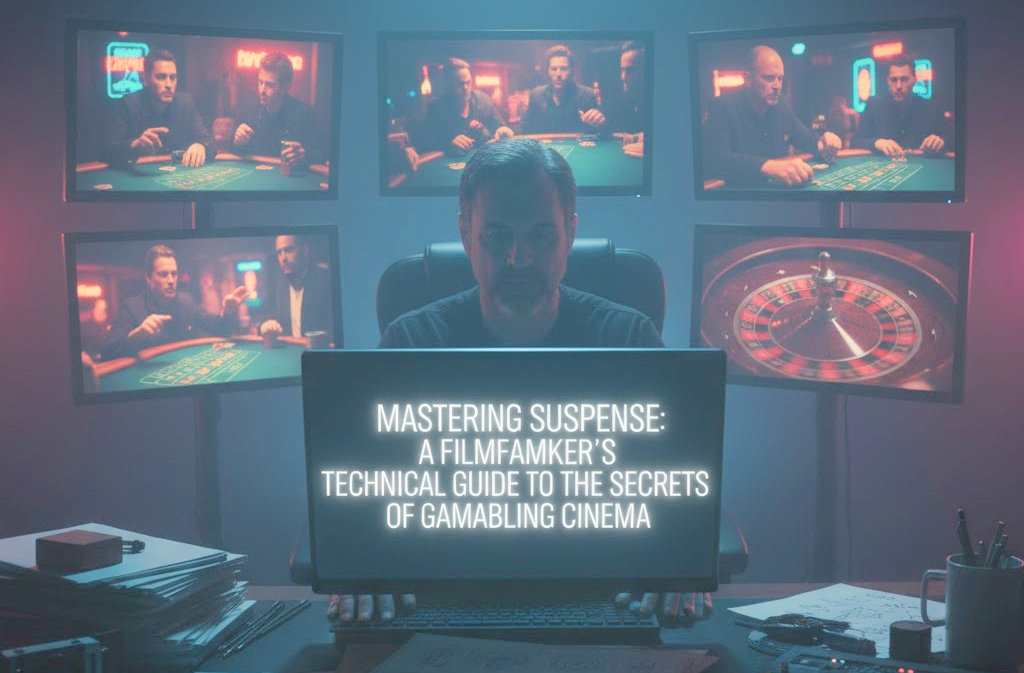
- Split-Screen Strategy: Split-screen shots are quite efficient in order to manage sequences with multiple simultaneous constraints or layers of information. This approach allows the film director to display key concurrent perspectives: the reaction of the player, the threat of the opponent, and an external menace that is time-sensitive (security closing in), all in the same image, and it is the best way to pack in a lot of data and a lot of tension.
You can comment below or join us on Facebook, Instagram! or Twitter
INDIE ACTIVITIES