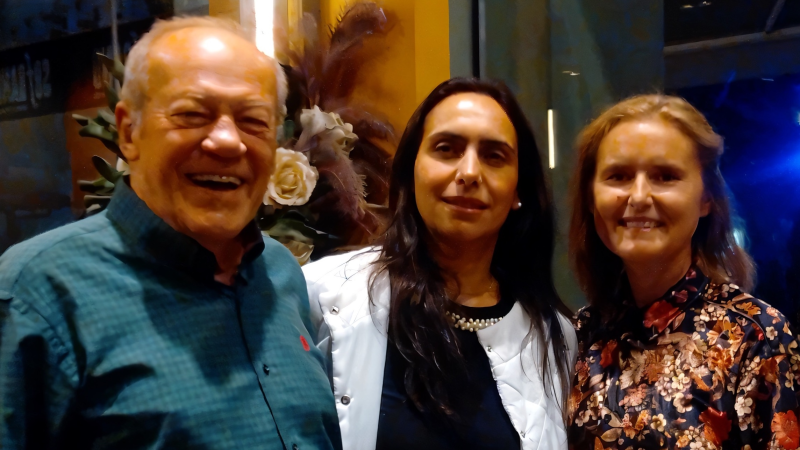
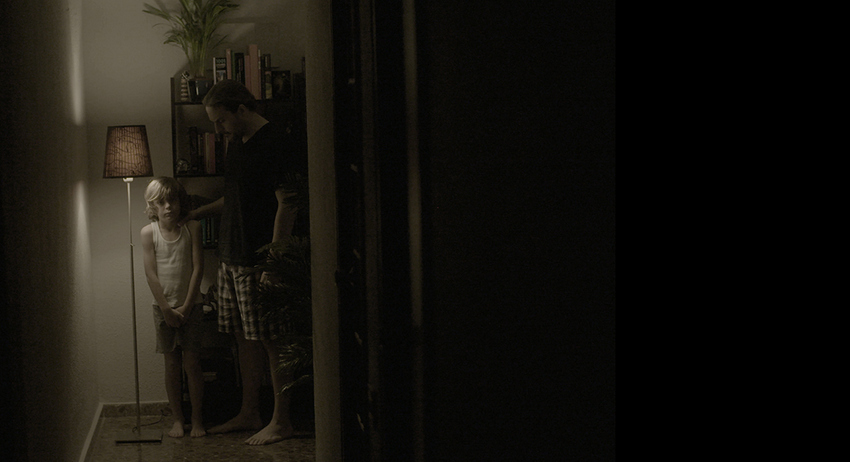
Marisa Crespo (MC): 9 Steps was a story that we had been maturing for several years. As creators, we are very prolific and store a multitude of short stories. This stories sooner or later will come to light. In this case, the story has an auto biographical point (I was very scared of the dark as a child). It also reflects one of our obsessions, which are father-son relationships within a dysfunctional family.
We chose this story because we are developing a feature film project also called 9 Steps. So, and we thought it would be a good sample of our authorial intentions. Besides we thought that the short film contained several messages important for us we want to spread.
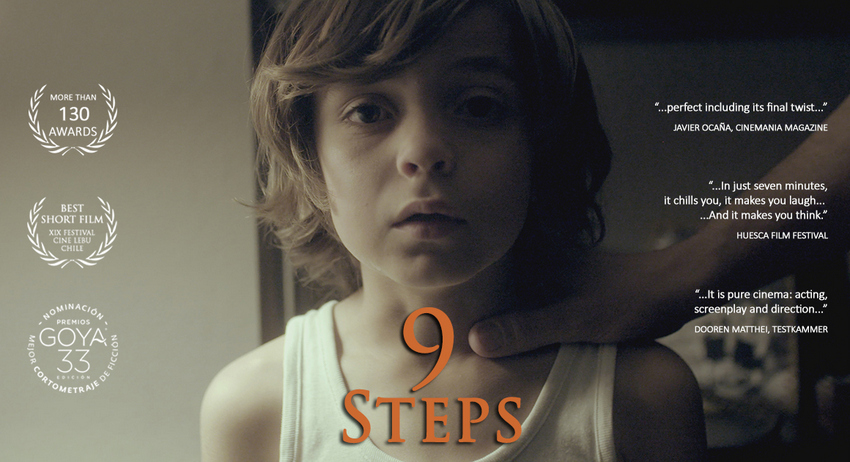
Related Story : ‘9 Steps’ Thriller By Marisa Crespo & Moisés Romera’s Wins 130 Awards
Moisés Romera (MR): We had written a script for a feature film with a thriller structure. And it had certain doses of suspense and terror. In which, as in everything we do, we show our obsessions with subjects such as family and education. Since, we had never directed anything with the intention of frightening. We decided to write and direct the short film 9 STEPS as a sample for the feature film project.
We decided to pay it with our savings, it was a personal bet. The production was simple because it is a play with few actors and only one location. The most complicated thing was to find the main character. A 7-year-old boy who has to be scared, cry and transmit all that emotion to the audience. After months of delay, we found Pablo and the whole process was hard. Yet very satisfying, because we have made a work that is pleasing both the public and the critics.
indieactivity: Did you start writing with a cast in mind?
Marisa Crespo (MC): No! In fact, we were very clear that one of the challenges would be to find the protagonist. And that we would need several castings. Normally, we don’t write thinking about a specific actor or actress. I base myself on people I know or characters I’ve been visualizing in my mind for some time.
Moisés Romera (MR): No! The main character must have been very young and talented to play the part. We spent a lot of time delaying the shooting until we found him. When it happened it was very exciting for us. The adult protagonist (the child’s father) is a professional actor with a lot of experience. After choosing him because of his physical profile and interviewing him, we came to that agreement.
How long did you take to complete the script? (Do you have a writing process?)
Marisa Crespo : This story is 10 years old. I told it to Moises, and we some months working on it, the twists, tone… Once we had it clean, we spent a couple of afternoons modeling and dialoguing. It was a very simple process.
Moisés Romera : The original idea had been in Marisa’s head for 10 years. When we decided to carry it out to support the feature film. So, we spent two or three months thinking about the tone. Also the tempo, the twists of the script and especially the end. Writing it took several afternoons, 2 hours each day.
What was your first project?
Marisa Crespo (MC): Our first project was Sirenito, a short film of 7 minutes (2004). Curiously, the main character is also called Saul. It tells the story of a five-year-old boy who asks his parents to go to the school fancy dress party dressed as Little Siren and the mess that the mother makes when she thinks her son is gay. Watch the Short here.
It’s one of our favorite ideas, although, at a technical level, you can see that we had an amateur team (and we, at that time, were amateur too). In spite of everything, Sirenito became a world-renowned work, and even today it is still used as didactic material.
Moisés Romera (MR): Our first work was SIRENITO (2004), a somewhat transgressive LGTBQ comedy, also in a family and also with a critique of education like 9 STEPS. Although the photography was very bad (we didn’t have a professional camera or a team with experienced people), I think it has a great script, which still works 15 years later. He was in more than 200 festivals all over the world.
Which scene (that made the cut) was the hardest to shoot?
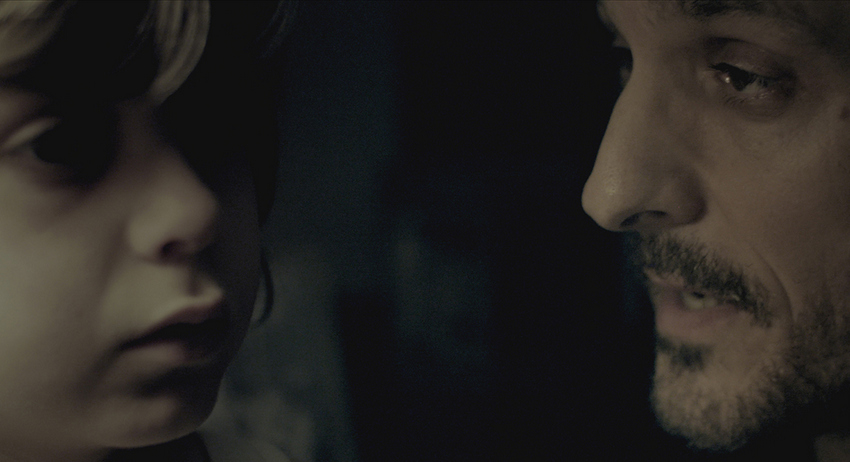
Marisa Crespo (MC): They were two, one in which Saul has to cry (if for an adult it is complicated to cry spontaneously, imagine for a child). And another in which the father shakes the child, every time Jordi shaked Pablo, the child got the laugh and we had to cut. In the end, we all ended up laughing.
The full film of 9 Steps by Marisa Crespo & Moisés Romera
Moisés Romera (MR): When Paul-Saul has to suffer from the panic of darkness and the pressure of his father. Fortunately, we rehearsed long before the shooting.
What worked better in this production that mightn’t worked well in the last one?
Marisa Crespo (MC): 9 steps is very simple at the production level, quite the opposite of Be what you want, a 2016 short film in which we worked with one hundred teenagers. It took several days of shooting and we had a large crew. It is impossible to compare the two works.
Moisés Romera (MR): Our previous production was in an institute and we employed over a hundred teenage extras, many of them with dialogue. It was a very complex production and if you produce it on a small budget, the risk is very high and there comes a time when you can’t delay shooting. This time the production was the opposite and we had control of everything that was going to appear on the screen.
Is there anything about the independent filmmaking business that you struggle with?
Marisa Crespo (MC): It would be great to get an economic return, but, at the moment, if you make an independent short film, you can only recover part of the costs if you win cash awards at festivals, or if you get a local television to buy it. It would be wonderful if the big Spanish TV Channels bought and broadcast short films. Or that festivals pay for selection, especially those that charge tickets to the audience.
Moisés Romera (MR): Yes: profitability. It would be a real business if the creators of short films could make a living from them, but at least in Europe this is a utopia. If big platforms like Netflix or Amazon bought quality short films, we would all win. And I think it would be a success in terms of audience.
Where do you think your strengths lie as a filmmaker?
Marisa Crespo (MC): I believe in what I do, and I love my job. I’m also lucky to have a person next to me who shares my passion for cinema (Moisés Romera). If I have any other strong points, I prefer the audience to list them. 😛
Moisés Romera : Tenacity, smell and a certain ability to compose images and manipulate the viewer. The most important thing is to work close to people who have more talent than you, and I do it together with Marisa Crespo. We’ve been working together for many years and we get along very well.
How was the film financed?
Marisa Crespo (MC): We financed the short film entirely with our savings. It was a story we wanted to tell and we did not hesitate to invest our money and our work. It also helped that the crew got involved in a very active way, we managed to shoot it in one day, for example, and that lowered the costs.
Moisés Romera (MR): 100% of our pockets. No family aid, no crowdfunding, no sponsor, no public or private aid from any institution.
What do you hope audiences get from your film?
Marisa Crespo (MC): 9 STEPS transmits in a very short time a great number of emotions, dosed millimetrically in the 7 minutes that the short lasts. The public projections are very gratifying, we love to camouflage ourselves among the spectators and to feel next to them. While they enjoy the short, we enjoy their sensations. It’s a symbiosis. At the end of the screening, many tell us that they have felt like when they were children, that this is one of our goals, and we love this.
On the other hand, as we did 9 steps as a sample for a long project, the great acceptance it is having (9 Steps has won more than 30 Audience Awards) gives us security on the feature film project. Well, that and a large number of people who, after seeing the short film, claim to be “wanting more” and ask us about the long project.
Moisés Romera (MR): Tension, terror, grief, surprise, laughter, tenderness and anger. Pure emotion. And a reflection when they finish watching the film. Yes, we know it’s very ambitious for a short film of seven minutes 😉
What else have you got in the works?
Marisa Crespo (MC): We have several feature film projects at various stages of development. One of them is 9 STEPS, in fact, we shot the short as a sample for this feature film project. I hope this will be next..
Moisés Romera (MR): We are working on the development of the feature film 9 steps and we are open to collaborations. In addition, we are working on other feature film projects, most of them very different from each other but with some innovative and genuine ideas. Always with the idea of entertaining, surprising and making people think.
Lets have your comments below and/or on Facebook or Instagram! or Twitter.
Follow 9 Steps on Social Media
Website
IMDb
Facebook
Twitter
Instagram
Vimeo
MORE STORIES FOR YOU

Broken Bird, Biracial Girl Conflict with Culture and Identity
A Short Film by Rachel Harrison Gordon is a coming of age drama SocialsWebsiteIMDbLinkedInInstagramVimeo
Year One with Elizabeth Yu A Coming-of-Age Drama Releases November
Freestyle Acquires Elizabeth Yu Coming-of-Age Drama YEAR ONE for November Release