
Like many good Southern girls, Brooke Hoover grew up in a tutu, taking dance class. While she loved dance class, she didn’t always quite “fit” in. But, loved to perform. Brooke parents recall one of their favorite dance recitals. They tell how she stayed onstage after the other dancers left. Brooke started doing her own crazy dance and waving to the audience. Everyone rolled with laughter.
Maybe that was the earliest spark of Brooke wanting to be an actor, to entertain people. But, she really attributed it to her first visit to New York. Her dad had work near NYC and her dad and Brooke had a quick weekend to see the town. They packed four Broadway shows into three and a half days. Brooke saw Jamie Farr (M.A.S.H.) who had just portrayed Nathan Detroit in Guys and Dolls exit the stage door. It was in a show merchandised umbrella (it was pouring rain) that it hit her.
Brooke wanted to pursue this not for stardom. Because, mind you, here’s an actor, leaving just like a normal person. Getting soaked like the rest of us) but for the love of the craft. She went home to school after that summer and worked her butt off. So, she could be part of the musical theater review at Hemingbough. A beautiful plantation-esque area that also served as a fundraiser for her school.
While Brooke wasn’t gifted in musical theater as a singer or dancer. Our drama club teacher and play director, the late Daniel Tiberghein (nicknamed “Mr T.”). He wrote in a role for Brooke as Helen and her best friend Gertie. They were basically these crazy old ladies who served as the emcees of the show. Brooke was 13 years old and she has never stopped. Mr. T. actually paved the way for a theme that still stays with Brooke to this day. If there is no work for you, no role for you…create your own.
indieactivity: How did you become an actor?
Brooke Hoover (BH): I knew then and there as I continued to do more school plays (Episcopal High School of Baton Rouge, Louisiana) which were more of excellent community theater, that I wanted to pursue acting as a living. I actively sought out smaller colleges with excellent theater programs, particularly colleges in the Northeast because I knew I wanted to end up in New York eventually.
It was our family friend Greg Pizzigno who suggested I look into C.W. Post Campus of Long Island University for acting. I remember I used a monologue from Neil Simon’s “Star Spangled Girl” and I definitely seemed a fish out of water, a wacky girl from South Louisiana at a serious theater school. The professor asked me to do the monologue (a comedy, of course) but this time again as a judge. It was the first time in my acting that I was actually using dramatic technique. I nailed it.

I was accepted into the school where we had rigorous training from Viewpoints and Suzuki technique (which works from tremendous physical energy to ground and center the actor) as well as the technique of Uta Hagen. I read and reread “Respect for Acting” freshman year.
Out of college, I was lucky enough to begin teaching children acting at The Actors Garage where many of our students have gone on to film, television and theater at a professional level. My boss, Ann Gray Graf encouraged me and paid for me to study at Upright Citizens Brigade where I studied Levels 101 – 301 improvisation.
I think improvisation is highly important for actors of all walks of life (meaning not just comedy but drama as well) because it takes you out of your head, something easy for many actors. It keeps things fresh even in your scripted scene work. To this day I still work with an improv troupe, Lunatic Fringe.
indieactivity: What acting technique do you use?
Brooke Hoover (BH): I pull a lot from the acting techniques in which I was trained. Sometimes without even knowing I am doing so because the training is so ingrained. Those techniques are as mentioned above, Uta Hagen’s technique, Viewpoints and Suzuki. I am big on using my given circumstances to create a character’s world and also using personal source to relate to a character when the given circumstances don’t seem to be enough for me to bring total truth to a scene and character. After all of that technique, I then, as an actor, have to let much of it go (as they say) so it doesn’t dictate a scene.

When I am involved in the scene and after I have done all of my homework and groundwork, then I rely on two “techniques” that go hand in hand. Acting coach and teacher at MN Acting Studio (and actor himself Van Hansis) tells us to “have thoughts”. It sounds so simple yet that’s what brings so much truth and immediacy to a scene. Basically, in life you are always having thoughts, acting and reacting, to what another person(s) is/are saying. In acting, you are having thoughts as your character. That is what keeps you most present in a scene.
Also, one of my best friends, colleagues from college and director of my two one woman shows Brian Lady says there is expectation and reality in acting as there is in life. Going along with with Van says (above), in life, you expect one outcome and then what actually happens is what dictates your reaction. Were you happy about that? Disappointed? Surprised? The emotion does not come from a place of “I must create an emotion” but from a genuine place of “that is not what I expected you to say / how I expected you to react”.
indieactivity: What wrong impressions do actors hold about acting?
Brooke: I believe many people assume actors can just turn on a switch and go. They don’t understand that there is a foundation of training that is years long and continues throughout an actor’s life.
indieactivity: Do you take courses to improve your craft?
Brooke Hoover (BH): I do train and study. I take classes and work on camera technique at our local union SAG-AFTRA Foundation offices. All of last year I was in classes at MN Acting Studio with coach Van Hansis. I am also lucky to be part of Brazen Giant Ensemble, headed up by Christian Keiber and Bill Sorvino who encourage writers to bring in new works, actors to bring in scenes and monologues to work on and to foster an environment of work, support and creativity.
What acting books do you read?
Brooke Hoover (BH): Of course Uta Hagen’s books “Respect for Acting” and “A Challenge for the Actor” are on my list as well as The Improv Handbook by Tom Salinsky and Deborah Frances-White. I also love reading actor autobiographies. I’m a huge fan of those by Mindy Kaling and Ali Wentworth.
How do you keep fit as an actor?
Brooke Hoover (BH): Every single day I have to do something to keep fit as an actor mentally and physically. It’s what keeps me sane in an unsure profession, in an unsure world. I guess you could say I’m a bit of a self help junkie but I’m the type who would much rather be at home doing Kundalini yoga with my dog than be out at a bar. It’s for my health and for my “office”. I am a big proponent of the concept that as a performer, our body and mind is our office and we have to respect it as such.
I meditate, do Kundalini and Vinyasa yoga, listen to inspirational podcasts and/or recite monologues while jumping on my trampoline, bike when the weather is appropriate and swim.
How do you prepare for a role?
Brooke Hoover (BH): My preparation is always different for every role I get. It always starts with the foundation of the mental and physical “actor office” work as I described above as well as the foundations of acting. However, since I also have my one woman shows (“Phat Girl Costumes” and “Wayward Souls”) working on those shows that don’t have a scene partner per se is a lot different than working on shows where I have someone else with whom to interact.
My work for my story telling based one woman shows and stand up comedy is from a physical more Suzuki based nature where I jump on my trampoline and do intense boot camp exercises while reciting the script in different tones to shake things up. Whereas, when I am doing scene driven acting work (i.e. on camera, theater) I talk about my character’s day from the mindset of that character. I go over my character’s given circumstances.
How do you create a character in a script into a person?
Brooke Hoover (BH): I ask myself questions about my character’s life: their given circumstances from their day to day life to their Zodiac sign (yes, that dictates a person’s behavior, I’m a little wacky like that) to how they grew up. That helps get into the mindset of a character.
How do you stay fresh on a production set?
Brooke Hoover (BH): I drink a lot of water, tea and try to step off and see nature (if possible) and do something physical whether it’s some stretching or something more physical like jumping jacks.
Describe a memorable character you played?
Brooke Hoover (BH): This is a hard one. I have two. Smitty from “Trust Me, I’m a Lifeguard” (2014) is definitely one. I remember seeing the breakdown on Actors Access when I submitted. They wanted a cross between Lori Petty and Melissa McCarthy. And, you had to be able to ride a jet ski. Roles that are perfect for me don’t come a dime a dozen. From the moment I saw the breakdown, I knew this role was for me. After going to the audition and call back, I had a feeling I had it. The team (including Christain Keiber and Tyler Hollinger, writers, producers and actors and Tony Glazer, director) was great to work with. People still come up to me at film festivals and talk about the one and only Smitty. You can now catch “Trust Me, I’m a Lifeguard” on Amazon, by the way.
Another role is Rowena Singh, my sketch character in our webseries “Pageant Pom Mom”. Rowena is a combination of myself and two of our family friends. She has a lot of hope, determination and stick-to-it-ive-ness and a love for her rescue dogs. She is an extension of myself. “Pageant Pom Mom” season one (2016) is viewable on YouTube and at our website www.PageantPomMom.com . I am also very proud of this role because it was a series written by myself and included character creation of all actors, not to mention starring my late rescue dogs Precious and Kibbles. We raised over $900 for rescue pets at our fundraiser. It’s a story about underdogs and I hope to one day create season two with my rescue dog Annie.
Explain one creative choice you took on set?
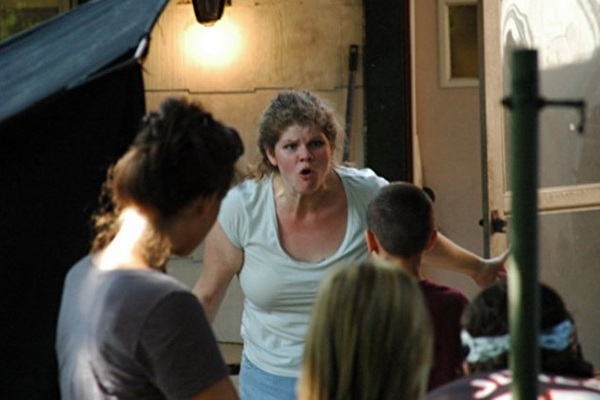
Brooke Hoover (BH): This was a creative choice we all took on set and I think it is a great example of low budget indie filmmaking at its finest. I was on the set of “Bunny” written and directed by Bob Snow. I played the role of Tracy, a young mom whose son (portrayed by Scott Clark) has stolen a pet bunny of a boy from a nearby town. When the two boys (portrayed by John Barbieri and Griffin Hyde – Griffin was a student of The Actors Garage, mentioned above) come to retrieve their pet bunny from my home, I confront the boys.
It was originally written that I corner the boys outside my home. But, due to rain, we had to shift things and I had to bring the two boys into my home. As a writer and director, Bob had to justify the “why” and as an actor, I also had to justify why I would bring two boys into my home to give them a lecture. I ended up yanking the boys by the necks of their shirts and giving my character the reason that I’ve got to bring the boys into the house because otherwise, they could take off running down the street.
A simple fix but it was great to really collaborate with Bob and the rest of the cast and crew to fix a problem. That is one reason I love indie film so, so much.
What do you want most from a director?
Brooke Hoover (BH): I want a director who can communicate well with actors. Who can get their message across in a concise and mindful way. A director who realizes actors are humans.
What actors do you long to work with?
Brooke Hoover (BH): Mike O’Malley.
Why?
Brooke Hoover (BH): I really enjoyed Mike’s work on the sitcom “Yes, Dear” some time ago. But, seeing that he can cross the boundaries of comedy and drama so seamlessly is very inspiring to me who’s also an actor who does both forms equally. Mike O’Malley is an actor who is a working actor – meaning he is consistently working and in excellent projects. So, from a business standpoint I really admire him. Seeing Mike’s work in “Glee” and “Sully” (to name a few) you see his thoughts, you see what is going on in his head, he brings a certain unique heart and humor to his work. I would love to work with him.
What advice would you give to actors?
Brooke Hoover (BH): Keep working on your craft, always remember why you got into acting (because you love it, because you can’t imagine doing anything else) and if you find yourself waiting too long between gigs for the next role, write something for yourself. I am proud to say I have created my own work including award nominated short film “SHYFT” which is hitting the festival circuit currently, web series “Pageant Pom Mom” and my two one woman shows “Wayward Souls” and “Phat Girl Costumes” along with a parody “Troll Under the Bridge”. My philosophy? Don’t wait, create. Involve yourself with organizations that foster connection and creativity. I am grateful to be part of NYWIFT and Brazen Giant Ensemble.
Briefly write about your career?
Brooke Hoover (BH): Brooke is an actor, writer and producer who has appeared on television shows including “Law and Order: Special Victims Unit” (two time co-star), “Quarry” and multiple times on ABC’s “What Would You Do?”. Brooke has had supporting roles in feature films including “The Girl Who Invented Kissing” (starring Dash Mihok, Vincent Piazza and Suki Waterhouse) and “The Runner” (starring Nicholas Cage and Sarah Paulson) and indie films “Hudson”, “Trust Me, I’m a Lifeguard” and “Crocodile Boy”. Brooke also creates her own works including one woman shows “Wayward Souls” (United Solo Artists Theater Festival) and “Phat Girl Costumes” (Emerging Artists Theatre New Works Festival) and comedy short “SHYFT” and web series “Pageant Pom Mom”.
You can comment below or join is on Facebook, Instagram or on Twitter
Socials
Website
IMDb
LinkedIn
Twitter
Instagram
YouTube
Vimeo
ACTOR INTERVIEWS


Actress Victoria Guthrie Demystifies Her Work
By Samantha Blackwell (Twitter)