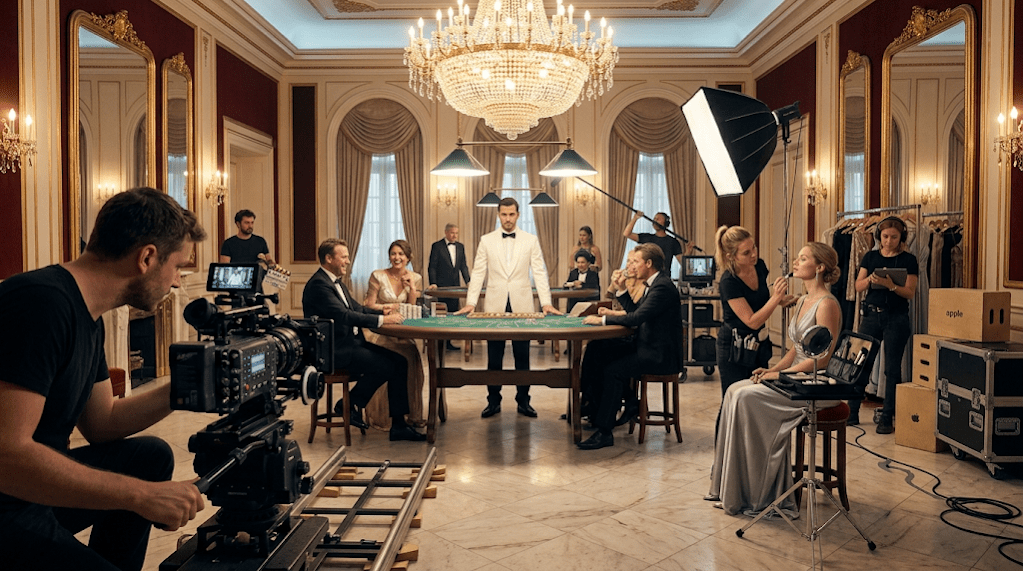
A casino looks like a gift to a director. Colour in every direction, motion that never stops, a hundred small human dramas running at once. Then you try to film one, and the gift starts sending invoices.
Paul Schrader said something useful about this while promoting The Card Counter. Making a casino scene look real was never the hard part. Because every casino on the planet already looks like every other casino. The hard part was making one look interesting.
That single problem sits under almost every gambling scene in independent film.
The floor fights the camera
The Card Counter shot for 26 days. Mostly on location around Biloxi, with the crew based largely at the Imperial Palace before branching out to other rooms on the coast. Real floors hand you production value for free. They also hand you low ceilings, flat overhead light, no windows and carpet patterns that eat every color you put in front of them.
Set dressers now face a second problem, which is that a big share of a modern floor is animation rather than furniture. The slots section of online casino Nepal shows the grid a designer has to match on screen: bright reel art, symbols readable from a distance, movement that runs whether anyone is watching or not. Get the pixel density wrong and the audience feels it before they can name it.
Then there is the business itself. Casinos earn around the clock and rarely stop for a film crew, so location shoots land in dead hours, in a roped off corner, or under a deal with a narrow window and a long list of rules.
Building the room can cost less than renting it
Mike Hodges went the other way on Croupier. The Golden Lion, that sleazy mirrored palace where Clive Owen deals blackjack, was a purpose built set at a German studio, and the whole film came in at around £3 million.
Control was the payoff. Hodges could light the room properly, run as late as he liked, and rebuild the space to suit the camera instead of squeezing the camera into a space designed for surveillance and slot revenue.
The set had a sting in it, though. All those mirrors meant the crew spent real effort staying out of their own frames. Hodges turned the artifice into the point, since Jack walks into a fake world and never quite walks back out. The film went on to take roughly $7 million and turned Owen into a name in America.
The game moved to a phone, and the camera noticed
Contemporary scripts brought a newer version of the same headache. Plenty of gambling now happens on a screen the size of a hand, with no felt, no chips and no croupier to cut away to.
A character opening MelBet NP on a phone gives you an accurate beat and almost no coverage. You cannot shoot a thumb for ninety seconds and call it tension. Directors get around it the same way they always have, by putting the camera on the face and letting the actor carry the outcome.
Uncut Gems built entire sequences out of that trade. The bet lives on a screen somewhere off camera, the drama lives in Howard’s eyes and in a television nobody in the room can turn off.
Everything gives you away at hand level
Extras decide whether the room reads as real. For the tournament sequence in The Card Counter, production reportedly filled the Coast Coliseum in Biloxi with around 500 of them, which is a lot of people to dress, feed and keep looking bored in exactly the right way.
Anna Boden and Ryan Fleck took the purist route on Mississippi Grind, shooting on film, on a budget near $7 million, in working casinos and racetracks along the river. Real rooms come with real patrons who slouch, stare and shuffle in a way no extra fully imitates.
The last tell is the hands. Anyone who plays will clock a bad chip riffle or a dealer who pushes cards like they learned it that morning. Plenty of smaller giveaways sit in the same frame:
- Clay chips click. Cheap prop sets rattle, and a boom operator will pick that up long before the audience consciously hears it.
- No floor supervisor anywhere in shot. Working pits always have one somewhere in the background, watching nothing in particular.
- Bets that ignore the table minimum sign sitting two feet away.
- A table where all six players are gripped by the same hand. Look at a real one and half of them are on their phones or waiting for a drink.
- Dialogue from the dealer. They talk far less than screenwriters want them to.