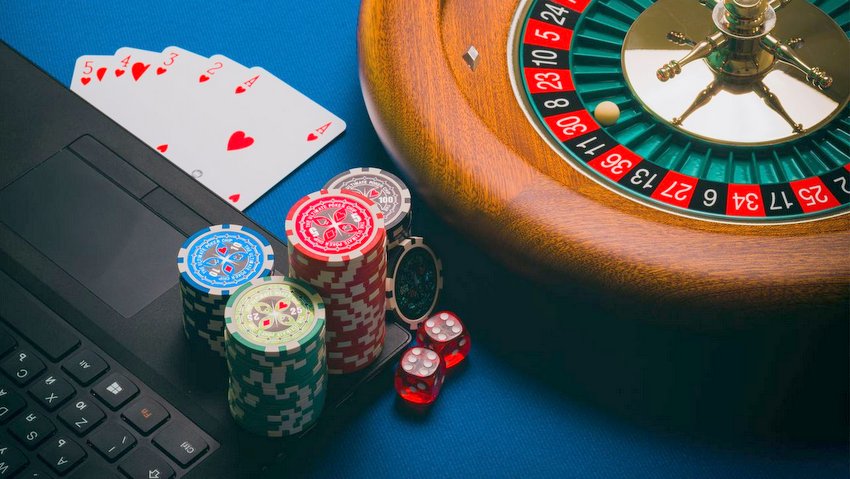
A roulette wheel is one of the few objects a director can put in front of a camera that generates suspense entirely on its own. It moves. It makes a sound. It takes a predictable amount of time to resolve, and when it does resolve, everybody in the frame finds out the answer at the same moment.
Screenwriters have been quietly exploiting this since the 1940s, and it is worth understanding why the wheel works so well before you decide whether to put one in your own film.
A clock you can point a camera at
Tension needs a deadline. Without one, a scene of people worrying is simply a scene of people worrying.
The wheel supplies a deadline that is visible, audible and impossible to argue with. From the moment the croupier releases the ball to the moment it settles, there is a fixed window of perhaps twenty seconds in which nothing can be undone. The bet is placed. The rattle starts. Every cut you make inside that window carries weight because the audience knows the clock is running down in front of them.
Directors preparing a scene like this often spend an evening watching online roulette simply to internalize the rhythm. The call for bets, the wave of the hand, the release, the long rattle, the settle, the announcement. Getting that sequence wrong is one of the fastest ways to lose a knowledgeable viewer, and it costs nothing to learn.
The wheel makes a private choice public
Cards are hidden. Dice are small and fast. A roulette wheel is large, central and open, which means a character’s decision sits on the table where everyone can see it.
That visibility is the dramatic gift. When a character pushes their chips onto a single number, they have told the room something about themselves without a line of dialogue. Desperation, arrogance, a death wish, a plan. The camera can hold on the other faces at the table and the whole exchange plays without a word.
Casablanca and the fixed spin
The most efficient use of a wheel in cinema is still the one in Casablanca. A young Bulgarian couple need money for exit visas. Rick, who has spent the entire film insisting he sticks his neck out for nobody, walks past the table and tells the husband to put everything on twenty two. He catches the croupier’s eye. Twenty two comes up. He tells him to let it ride. Twenty two comes up again.
No speech, no confession, no change of expression. The wheel does the character work, and it does it in under ninety seconds of screen time. That is the model to study.
Croupier and the view from the other side
Mike Hodges took the opposite approach in Croupier, made for around three million pounds and opening on a wheel before it shows you anything else. Clive Owen plays a dealer rather than a gambler, and the film is shot from behind the table looking out.
The tension there is not about whether a number lands. It is about a man watching other people lose and slowly discovering how little he feels. Hodges keeps the camera low and tight, uses voiceover against the image rather than with it, and never once cuts away to the sort of establishing wide shot a bigger production would have insisted on. The BFI’s guide to where to begin with Mike Hodges is a good route into his work, and Croupier in particular repays close study by anyone planning a contained single location feature.
Shooting the spin
Practically, the scene is cheaper than it looks and harder than it looks.
A hire table and a dressed corner of a room will read as a casino floor if you light it right, since the audience’s mental image is mostly haze and a pool of light over green baize. What you cannot fake is continuity. Ball position, chip stacks and the croupier’s hands all have to match across takes, so budget a rehearsal and cast someone who can handle a rake.
Cover it with three angles. A wide that establishes the table and the faces, a tight on the wheel, and a close on whichever character the scene belongs to. Cut between them on the rhythm of the ball rather than the dialogue.
What the wheel gives a small production
For a first or second feature, the appeal is obvious. One location, a handful of extras, a prop that does your pacing for you and a device that can turn a character’s inner state into something an audience can watch.
The trap is treating the outcome as the point. A scene built around whether the number comes in is a scene with one beat. A scene built around what somebody is willing to risk, and what the people watching them make of it, keeps working long after the ball has stopped. Lighting and lensing carry most of that weight, which our piece on the impact of cinematography on atmosphere and emotion goes into in more detail.
You can comment below or join us on Facebook or Twitter.
INDIE ACTIVITIES

Iconic Actress “Irina Maleeva” Brings “Sunny’s Closet” to Indiewood
International Actress at Film Festival with “Sunny’s Closet” — Before Taking It To Rome